
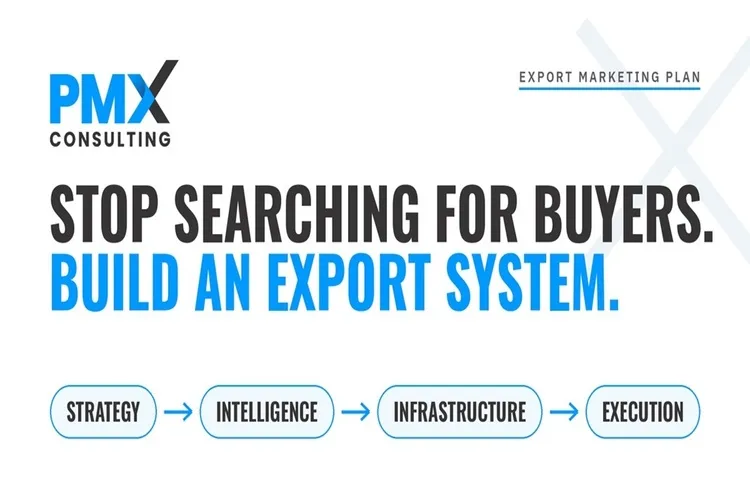
Why the first request most Pakistani manufacturers make — “find us foreign buyers” — is the wrong place to start.
When a Pakistani manufacturer decides to grow exports, the request we hear most often is disarmingly simple: “Find us foreign buyers.” It is an understandable instinct. Buyers are where orders come from, so buyers must be the starting point. In practice, this is exactly where a great deal of export effort quietly fails.
A list of foreign companies is not a market strategy. A trade-fair visit is not a pipeline. A CRM full of contacts is not a customer. Each of these is a useful component — but a component only produces results when it is connected to the others through a deliberate process. Exporting is not a chance sale. It is a system.
The database illusion
Suppose you acquire a database of 5,000 foreign companies. It looks like opportunity. But ask the harder questions: How many actually buy your product? How many fit your production capability and volumes? How many operate in markets where your price and standards let you compete? How many have any reason to change their current supplier? Once those filters are applied, 5,000 contacts often become a few hundred realistic targets — and the manufacturers who chase the raw list exhaust their sales energy on noise.
The goal was never the largest database. It is the right market, the right company, the right decision-maker, the right proposition and disciplined follow-up. Volume feels like progress. Relevance produces orders.
Four things that have to work together
A durable export capability rests on four pillars. Weaken one and the others lose their force.
1. Strategy — Where should we compete?
Which products deserve priority, which countries, which customer segments. Strategy decides where effort is spent before a single email is sent.
2. Intelligence — Where is the opportunity?
Trade flows, market size, industry concentration, competitors, prevailing prices, standards and distribution channels. Intelligence replaces “we want to export to Europe” with a specific, evidenced target.
3. Infrastructure — Are we buyer-ready?
Website, positioning, technical collateral, customer database and CRM. When a foreign buyer receives your email, the next thing they do is search your company. Your website has joined the sales meeting before anyone from your company is present.
4. Execution — How will we win customers?
Outreach, distributor development, trade-fair follow-up and structured pipeline management — the discipline that turns a first contact into a quotation, and a quotation into a customer.
Strategy → Intelligence → Infrastructure → Execution. The direction matters. Starting with email addresses reverses the logic; starting with strategy compounds every step that follows.
Europe is not a strategy
“We want to export to Europe” is one of the most common — and most expensive — statements in Pakistani manufacturing. Germany may present a completely different opportunity from Poland, Italy or the United Kingdom: different buyers, different price expectations, different standards, different routes to market. Select before you sell. Market selection precedes outreach; it does not follow it.
Different products, one disciplined process
The pillars are constant; their application is specific to each business.
For MSCLX Hydraulic
the work spanned market and customer identification, distributor and machinery-maker mapping, end-user and competitor analysis, pricing intelligence, CRM setup, distributor engagement, industry associations and digital marketing.
For BECO wire harnesses
it began further upstream — product and HS-code definition, trade analysis and market sizing, OEM and Tier segmentation, ideal-customer-profile development, geographic prioritisation, competitor analysis, positioning and sales strategy, through to operational readiness.
Two very different products. One disciplined export-development process applied to each.
What an Export Marketing Plan actually contains
An Export Marketing Plan (EMP) is not a document that sits in a drawer. It is the working system that connects the parts: market selection, customer segmentation and ICP, competitor and pricing intelligence, positioning, website and collateral, buyer database, CRM, outreach, distributor development, trade-fair strategy and follow-up. Each element supports the others. Together they turn manufacturing capability into a repeatable route to international customers.
Your factory may already be ready
Your factory may already be ready
Here is the encouraging part. If your company already manufactures a competitive product, the export problem is usually not production. It is the absence of a repeatable path from Factory → Market → Customer → Contact → Conversation → Quotation → Order. That path can be designed, built and managed — and that is precisely what the PMX Export Marketing Plan is for. Don’t just search for buyers. Build an export system.
Discuss Your Export Market
Tell us what you manufacture and where you want to grow. PMX will help you see where your current export system stands and what to build next.
PMX Consulting — Building Global Businesses
Led by Imtiaz Rastgar — Manufacturer since 1967 · Former CEO, Engineering Development Board (2004–2007) · CBI Netherlands expert since 2007.
www.pmx.com.pk · info@pmx.com.pk · +92 334 593 3391
