
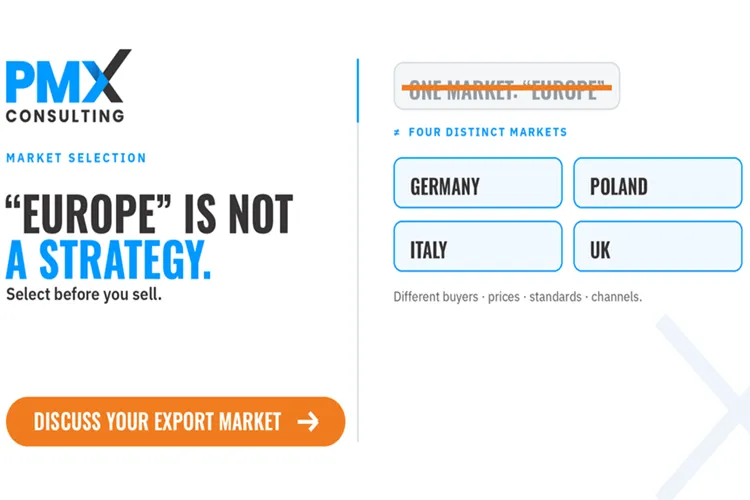
“We want to export to Europe” is not a market strategy. It’s a wish with a continent attached.
Ask a room of Pakistani manufacturers where they’d like to export, and you’ll hear the same three answers: Europe, the Gulf, and “wherever the orders are.” All three feel like ambition. None of them is a decision.
Europe is 44 countries, a dozen buyer types, and tariff and standards regimes that change every time you cross a border. Germany is not Poland. An OEM in Stuttgart is not a wholesaler in Rotterdam. Saying “Europe” tells your export effort nothing about what to make, who to call, or what price to quote. It just points you at a map and wishes you luck.
Choosing a market is one of the highest-leverage decisions you’ll make — pick right and everything downstream gets easier; pick on instinct and you’ll spend two years and a lot of airfare learning you were never going to win. So it deserves more than a gut feeling. Here’s how the decision should actually be made.
Start with the trade data, not the aspiration
Before you fall in love with a country, look at what that country is actually buying. The question isn’t “where would we like to sell?” It’s “where is real, growing demand for exactly what we make?”
The data exists and most of it is free. Tools like ITC Trade Map, UN Comtrade, and TDAP’s own datasets will tell you, for your specific HS code, how much each country imports, whether that number is rising or falling, and who they currently buy from. A market that imports $2 billion of your product and is growing 8% a year is a different proposition from one that imports $300 million and is shrinking — no matter how good the first one feels.
Pull the last three to five years. You’re not looking for a big number; you’re looking for a big number that’s moving in the right direction.
Size is not the same as accessibility
A large market can be completely closed to you, and a smaller one wide open. What matters alongside total demand is concentration — is that demand spread across hundreds of importers and distributors, or is it locked up by three OEMs who qualified their suppliers a decade ago?
A fragmented market with many mid-sized buyers is far easier to enter as an unknown new supplier: you only need a handful of them to say yes. A concentrated OEM market can be enormous and still take you three years and a full qualification audit just to get on the list. Neither is wrong — but they demand completely different strategies, timelines, and budgets. Know which one you’re walking into before you book the flight.
Understand who you’re really competing against
You are never the only option on a buyer’s desk. Someone is already supplying this market — usually China at the low end, often India, Turkey, or Eastern Europe in the middle, and Germany or Japan at the top. Your job is to find the gap where you genuinely fit.
This is where the China+1 logic earns its place. You will not out-price China, and you shouldn’t try. What you can offer a buyer who is nervous about single-country dependence is a qualified second source — same component, lower concentration risk. That’s a real, current reason to talk to a Pakistani manufacturer, and it only works if you’ve picked a market where buyers are actually feeling that pressure. Map the incumbents and their price points first, then position into the space they’re leaving open.
Do the pricing maths honestly — landed, not ex-works
Your factory-gate price is not the price the buyer sees, and this is where a lot of export dreams quietly die. The number that matters is your landed cost: ex-works price plus freight, insurance, tariffs, and the distributor’s margin, sitting on the buyer’s dock in their currency.
Check the tariff line carefully, because it can swing the whole equation. Pakistan’s GSP+ status with the EU removes duties on a wide range of goods — a genuine, often underused advantage that can make a European market viable where it wouldn’t otherwise be. Then compare your landed price to the incumbent’s. If you’re landing 20% above them with no quality or reliability edge to justify it, that market is a polite “no” — better to learn it from a spreadsheet than from six months of ignored quotations.
Match the market to how the product actually sells
Every market has a dominant channel, and every channel has its own rules. Does the product reach the buyer direct-to-OEM, through importers and distributors, via aftermarket wholesalers, or increasingly through B2B e-commerce? Each one asks for something different — certifications, minimum order quantities, branding, credit terms, the ability to hold inventory locally.
Pick a market whose dominant channel you can realistically serve. A market that only buys through large distributors demanding 90-day credit and local stock is a bad fit for a manufacturer who can’t finance that — regardless of how attractive the demand data looked.
Then hold up the honest mirror: can you actually serve it?
The last filter is the one manufacturers skip because it’s uncomfortable: capability fit. Does this market require certifications you don’t hold (CE, ISO, E-mark for auto parts)? Can you meet its volumes without starving your domestic orders? Can you hold a lead time and keep it? Can your team correspond commercially in English and turn a serious enquiry around in a day, not a week?
A market you can’t serve reliably is worse than no market at all. One late or failed order in a new export relationship doesn’t cost you an order — it costs you the buyer, and often the reputation that would have opened the next three.
From the whole world to a shortlist of two
Put those filters in sequence and market selection stops being a wish and becomes a funnel:
- Start wide — 15 to 20 candidate countries, ranked purely on trade data: import size and growth for your HS code.
- Narrow on competition and pricing — cut it to five or six where you can actually land competitively.
- Narrow again on channel and capability fit — down to the two or three you can genuinely serve.
- Then go deep on those. Not ten markets shallow. Two markets, properly.
Depth compounds and breadth scatters. The manufacturer who wins one market completely — the right buyers, the right channel, a reputation for reliability — is far ahead of the one with a passport full of stamps and no repeat orders.
The bottom line
“We want to export to Europe” points at a continent. A market strategy points at a country, a product, a channel, and a buyer type — chosen because the data says the demand is real, the competition is beatable, the price works landed, and you can actually deliver. That’s the difference between exporting by chance and exporting by system.
This is exactly what the PMX Export Marketing Plan does — it turns “we want to export” into a ranked, evidence-based shortlist of target markets, with the trade data, competitive picture, and channel strategy worked out before you spend a rupee chasing the wrong country.
👉 [Explore the PMX Export Marketing Plan] or [discuss your export market with us] — bring the product, we’ll help you find where in the world it should go.
PMX Consulting · Building Global Businesses · www.pmx.com.pk
