“Anyone who buys our product” is not a customer definition. It’s the absence of one.
Every manufacturer, asked who their export customer is, wants to say “anyone who needs what we make.” It sounds open-minded and commercially eager. It is, in practice, a recipe for chasing everyone and reaching no one — burning your team’s time on enquiries that were never going to convert, in countries you were never going to win.
When you’re selling across an ocean, focus isn’t a nice-to-have. You cannot knock on every door in the world, attend every trade show, or answer every half-serious enquiry with equal energy. The exporters who succeed are the ones who decided, in advance and on paper, exactly who they were trying to reach — and then ignored everyone else. That decision is your Ideal Customer Profile (ICP), and it’s the foundation everything else in your export plan is built on.
Here’s how to build one that actually works.
The seven dimensions of a B2B export ICP
A real ICP is specific enough that your team can look at any company and say “yes, that’s us” or “no, that’s not” within thirty seconds. To get there, define your ideal customer across these dimensions:
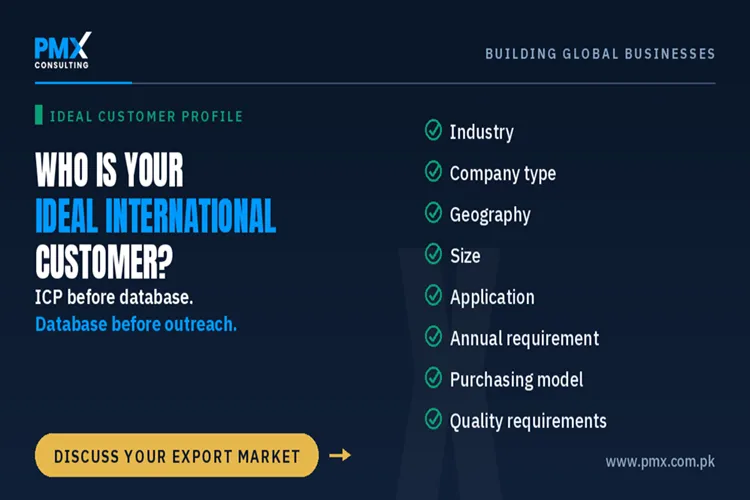
1. Industry / sector
Which industry actually uses your product? Not “manufacturing” — that’s a continent, not a target. If you make precision machined components, are you serving automotive, agricultural machinery, textile equipment, or oil-and-gas? Each has different buyers, standards, and buying rhythms. Pick the one where your product is a strong fit, not a stretch.
2. Geography
Not “Europe.” A country, chosen on evidence — import demand, competition, landed price, and the channel you can serve. (This is the whole subject of market selection; if you haven’t nailed it, that comes first.)
3. Company type — where they sit in the chain
Is your ideal buyer a distributor, an OEM, an importer, or an end user? This single choice changes everything downstream, and it deserves more attention than it usually gets — more on it below.
4. Application
What does the customer actually do with your product? The same component can be a critical safety part in one application and a low-stakes commodity in another. Knowing the application tells you what the buyer cares about — price, precision, certification, delivery — and lets you speak to it directly.
5. Annual requirement — volume and size
How much do they buy in a year, and how big are they? A buyer whose annual requirement is 2,000 units when your economic minimum is 50,000 is not your customer, however friendly the meeting was. Define the size band you can serve profitably — big enough to be worth it, not so big you can’t supply them reliably.
6. Quality requirement and standards
What certifications and quality levels does this customer demand — ISO, IATF 16949, CE, E-mark, RoHS? This is a filter in both directions: it rules out customers whose standards you can’t yet meet, and it rules out markets that would treat your hard-won quality as an unrewarded expense. Match your quality to buyers who value it.
7. Buying model
How does this customer actually purchase? Long qualification cycles and annual contracts (typical of OEMs)? Spot buying on price (typical of some importers)? Stock-and-distribute with credit terms (distributors)? Your ideal customer’s buying model has to be one your business can actually finance and service.
Write all of this down as a single, concrete paragraph — a profile so specific that a stranger could use it to sort a list of companies for you. That paragraph is worth more than any database.
The sequence that everything depends on ICP before database. Database before outreach
Most export efforts run this backwards. They buy or scrape a huge list of contacts, then start emailing, then wonder why nothing lands. They built the database before they knew who they were looking for, so the database is mostly noise — and then they poured their outreach on top of the noise.
Define the ICP first. Only then do you build a target list, because now you know what a target is. And only once that list is qualified do you begin outreach. Skip a step and you don’t save time; you spend it, at the far end, on rejection.
Why 100 beats 5,000
This is the instinct the ICP exists to correct: the belief that more contacts means more chances. It doesn’t.
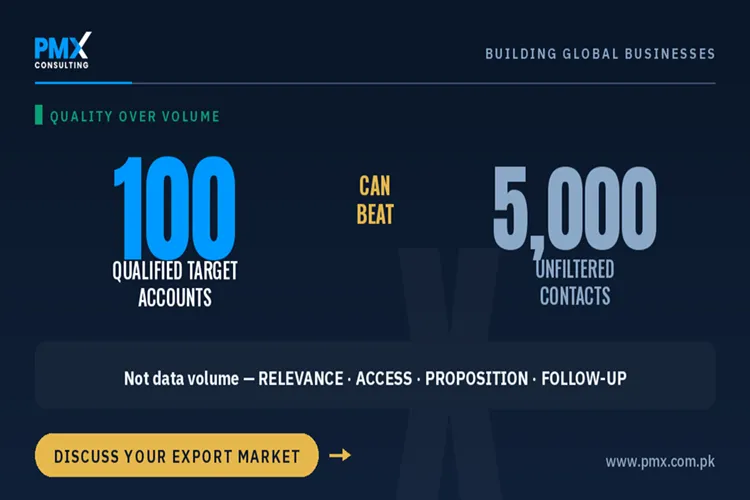
100 qualified target accounts are worth more than 5,000 unfiltered contacts — every time. The objective was never data volume. It’s relevance (are these genuinely the right companies?), access (can you actually reach the decision-maker?), proposition (do you have a real reason for them to switch?), and follow-up (can your team pursue them properly?). You can do all four for 100 accounts. You can do none of them for 5,000.
A tight list of the right companies, worked seriously, will out-perform a bloated list worked superficially — and it will save your team from the demoralising grind of chasing people who were never going to buy.
Channel is a decision, not a detail
The one dimension manufacturers most often leave vague is company type — and it’s the one that reshapes the entire approach. A distributor, an OEM, an importer, and an end user are not interchangeable customers. They are four different businesses that happen to touch the same product.
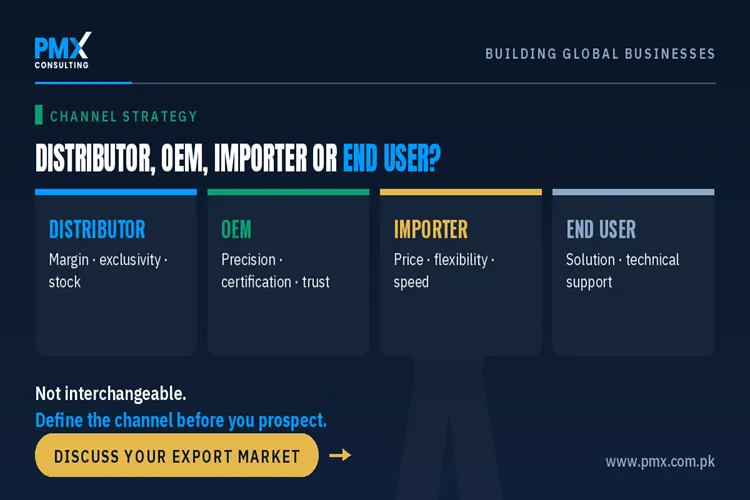
- A distributor wants margin, exclusivity, marketing support, and stock they can move — you’re selling them a business opportunity.
- An OEM wants precision, certification, and absolute reliability, and will put you through a long qualification before a single order — you’re selling them trust.
- An importer often wants price and flexibility, and moves fast — you’re selling them a deal.
- An end user wants the product to solve their problem, and needs technical support you may not be set up to give at a distance.
Each demands a different value proposition, margin structure, technical support model, and sales approach. Your export plan should decide which channel you’re pursuing before your team starts prospecting — because a pitch built for a distributor will fall flat on an OEM, and time spent learning that the hard way is time you don’t get back.
/
How to actually build yours
You don’t need to invent your ICP from theory. Look at your best existing customers — the ones who order repeatedly, pay on time, value your quality, and don’t grind you on price. Find what they have in common across the seven dimensions above. That pattern is your ICP. Write it down, turn it into a simple scoring checklist, and use it to sort every prospect and every enquiry from now on.
The manufacturers who win in export markets aren’t the ones who cast the widest net. They’re the ones who knew exactly what they were fishing for.
This is where the PMX Export Marketing Plan begins — we help you define a precise, evidence-based ICP, then build the qualified target list and channel strategy around it, so your team spends its energy on the hundred accounts that can actually become customers.
👉 [Explore the PMX Export Marketing Plan] or [discuss your export market with us] — let’s define exactly who your next customer should be.
PMX Consulting · Building Global Businesses · www.pmx.com.pk